Today I want to discuss a video game, one you’ve probably heard of if you’re into video games, Katamari Damacy. As always my posts have almost nothing to do with current trending topics and instead have to do with whatever random design related thought floats to the top of my brain. And right now that thought is “Katamari has some of the most unique interaction design I’ve experienced”.
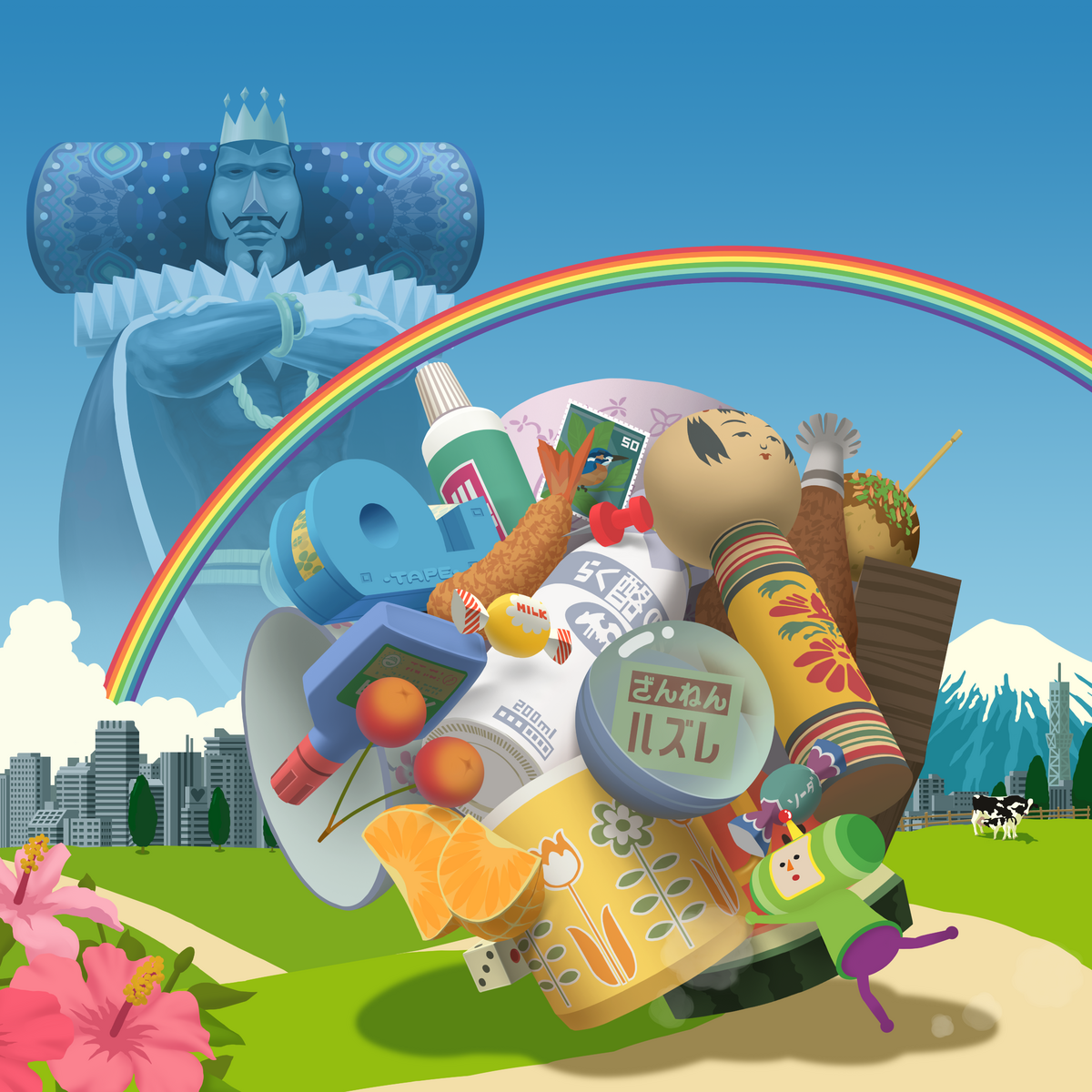
Key art for the second game in the Katamari series, which in my opinion is just as good as the first game.
Katamari Damacy, released in 2004, is a game where you roll a ball around, collecting objects as you roll and making your ball, your “katamari” bigger. And when I say bigger I mean bigger, (spoilers for a 22 year old game) you start out with a tiny katamari, rolling up tiny things like paperclips, tiny bugs, and strawberries, eventually moving up to objects as big as houses, cities, and even islands, and finally in the credit sequence of the first game, rolling up all the countries of the world. The simple premise of “roll thing get bigger” leads to a very intuitive feeling progression system, making your katamari bigger is incredibly satisfying and as you grow your katamari and are able to roll up objects that were previously barriers, new areas of a level will unlock.
This is the core gameplay loop, roll something up, get bigger, find new things to roll up, repeat until a level is complete. Sometimes getting as big as possible within a time limit is your goal, and sometimes reaching a certain size as quickly as possible is your goal. And sometimes there are other specific goals, like rolling up as many crabs as you can, and there are hidden unlockable characters and items that you can roll up. The gameplay loop is straight forward and allows the interaction design, i.e. the mechanics of the game to really shine, while also being a very unique gameplay loop, not found in many games that predate Katamari.
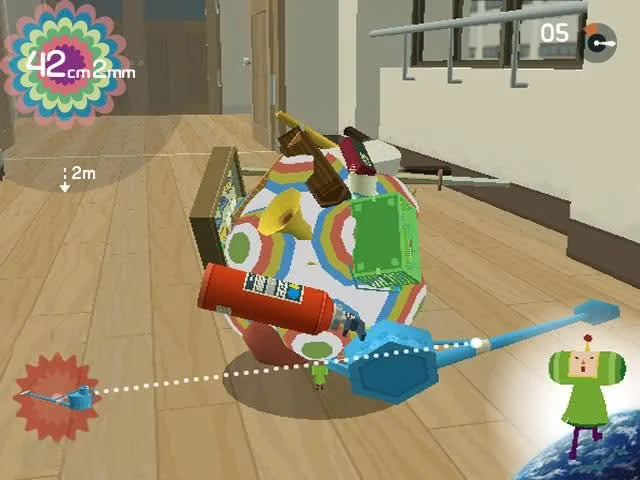
A screenshot from Katamari Damacy
When encountering interaction design experiences, be they video games, websites, apps, devices, interactive exhibits or something else entirely, I am always hoping to find interaction methods that are truly unique, and Katamari was truly unique when it was released. Your character, The Prince of all Cosmos, (in addition to having unique controls Katamari also has a very quirky and unique setting), is mostly controlled by moving both joysticks on your controller at the same time to roll your Katamari ball around. It was a control system unlike any other for its time and it really does simulate the feeling of rolling a giant ball around in front of you. While the controls are simple to understand, the learning curve of mastering them can be quite steep, this I think is an indicator of how good a game it is. The creativity of the core gameplay loop, and simplicity of the controls, combined with depth of difficulty the tougher levels can present, is what makes this game so good. There is no bloat in Katamari, no unnecessary leveling systems, or tacked on half-baked mechanics that take attention away from the core mechanic of rolling your Katamari and making it bigger. The simplicity of the mechanics is what makes the game so good, it’s a game that knows how it wants its players to interact with the world, and it does that well.
The simple mechanics also contrast with the over the top art style. Katamari, as you might have noticed from the images I’ve included, is a crazy colorful, visually overwhelming sensory experience. The aesthetic is campy and bright and silly and weird in such a fun way, but if there were say, a bunch of menus also on the screen, I think that aesthetic could easily feel overwhelming to players. The simple interaction design allows for a wacky fun art style, and prevents the game from feeling like too much. The simple interaction design also really gives a spotlight to the music, the music in this game is great, with lyrical songs from genres such as funk, j-pop, and jazz, it feels great to be rolling along while singing “I wanna roll you up into my life”, and if it wasn’t for the simple mechanics, the boisterous lyrical music would probably feel overwhelming.
Katamari Damacy, in addition to being a great game from an interaction design perspective, is also in my opinion a great work of art. The game was intended by its creator as a commentary on consumer culture, the act of endlessly rolling up objects mimics our own overconsumption, and throughout the game as you roll up a myriad of man made objects such as paperclips, sandals, old magazines, sponges, plastic toys, and gum packets, you can’t help but contemplate just how much human made detritus there is in the world. Each item type you roll up is put into a collection log that can be accessed from the overworld and viewing that log shows emphasizes how much man made objects there are in the game (and in real life) compared to natural objects like plants and fish and fruit.
The game is also darkly satirical against its bright and wacky backdrop, (plot spoilers ahead for a 20+ year old game), the main plot of Katamari is that the King of all Cosmos got drunk and accidentally destroyed all stars in the cosmos except for Earth. He then asks (or rather orders) his son, your character, the Prince, to roll up objects on Earth so that he can remake the stars. The King’s wanton disregard for the cosmos can be compared to our own disregard for our planet, and the all consuming Katamari that proceeds to roll across the planet that threatens the Earth as an equally horrifying and hilarious Kaiju, can easily be read as a metaphor for our own horrifying yet hilarious overconsumption destroying the planet, as we slowly consume the planet with our plastic water bottles, old t-shirts, and discarded TVs. The irony of a Katamari that is in large made up of our own detritus rolling across the landscape, and ultimately consuming us humans, is both darkly funny and an apt metaphor of our current climate crisis.
This whole metaphor of overconsumption is built upon the interaction design, upon the mechanic of rolling up objects, getting bigger and rolling up more objects, and this is perhaps the biggest reason that I love Katamari Damacy, the interaction design works in tandem with the artistic message, and that artistic message is directly tied to the mechanics and made more impactful by them. If Katamari was not a game about rolling up objects and consuming the world, the anti-consumption messaging would not work as well as it does, nor would the dark satirical angle. This is in my mind, the best type of interaction design as art, when the interaction a user does supports the message of the art. And indeed if games deserve to be called art (which I believe they do), then Katamari must surely be ranked among the one of the best games ever made from an artistic perspective, not only a design perspective.
If you are interested in my research, please visit my website’s about page.
If you are interested in collaborating with me in some way, please reach out to me on Linkedin.